Interview Transcription Software vs Human What Pros Choose
- May 22, 2026· Article by Alex Reed
- Automated Transcription
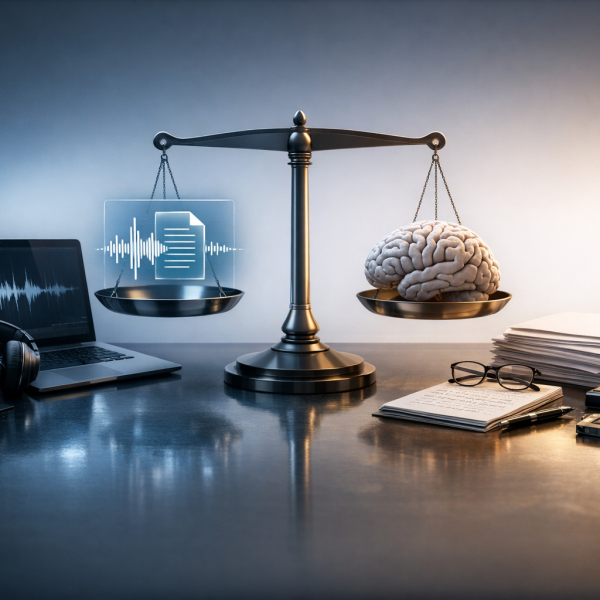
Choosing between automated transcription tools and professional human transcribers is no longer a simple matter of speed versus accuracy. With AI advancing quickly and businesses dealing with more audio and video content than ever, the way you capture spoken words on the page can directly impact search rankings, legal compliance, and brand authority. Understanding where software shines and where humans are still essential is the first step toward building a smart, scalable transcription strategy.
1. Accuracy
When it comes to accuracy, automated transcription software has made big strides, especially for clear audio, general topics, and standard accents. Many platforms can now claim impressive word recognition rates in ideal conditions. However, real-world recordings are rarely perfect. Background noise, overlapping voices, technical jargon, and strong regional accents all reduce machine accuracy, often in ways that are hard to predict or control.
Human transcribers, especially trained professionals, still outperform software in complex situations. They understand context, infer missing words, interpret slang, and distinguish similar-sounding terms based on subject matter. For industries like legal, medical, or research, where a single misheard term can have serious consequences, professionals remain the preferred option. Brands that care about credibility and compliance usually treat automated tools as a starting point, then rely on human review for final quality.
2. Multilingual Needs and Certified Workflows
In global business, transcription rarely stands alone. Audio in one language often needs to become written content in another, sometimes with legal validity. Automated tools can transcribe and even translate in multiple languages, but their performance is inconsistent across dialects and specialist fields. For official documents, immigration cases, or international contracts, machine-only workflows simply do not meet regulatory standards.
This is where human linguists and integrated language services come in. Professional providers can combine accurate transcription with translation, cultural adaptation, and legal certification in one process. If you need transcripts that hold up in court, support visa applications, or meet strict corporate or government requirements, working with a team that offers online certified translation services alongside transcription is the safest route. Pros know that in regulated environments, documentation has to be verifiable, traceable, and fully compliant.
3. Turnaround Time and Scalability
Speed is one of the strongest arguments for interview transcription software. Automated tools can produce a draft transcript in minutes, sometimes almost in real time. For newsrooms, content creators, podcasters, and marketers handling high volumes of recordings, this near-instant output is extremely attractive. It allows teams to skim content quickly, locate key quotes, and repurpose audio into blogs, captions, and social posts at scale.
Human transcription, in contrast, usually takes hours or days, depending on audio length, complexity, and service level. However, experienced agencies use teams of transcribers, editors, and quality controllers to handle large projects reliably. They also offer tiered turnaround options for urgent work. Professionals often combine both methods: software generates an initial draft for speed, and human experts refine and verify it. This hybrid model provides a solid balance between rapid delivery and dependable accuracy.
4. Cost: Upfront Savings vs Hidden Risks
Automated transcription tools are usually cheaper on a per-minute basis, or even bundled into existing platforms at low subscription costs. For routine internal meetings, brainstorming sessions, or content that will never be seen outside the company, this is often enough. The financial argument is clear: machines offer predictable pricing and can process massive amounts of audio without extra labor.
However, cost looks different when errors have real consequences. Inaccurate transcripts in legal, medical, or compliance-heavy sectors can lead to disputes, misunderstandings, or even regulatory penalties. In marketing, poorly transcribed interviews can damage brand perception and undermine content strategies. Professional human services may have higher upfront prices, but they reduce the risk of rework, corrections, or reputational damage. Experienced teams also set clear expectations and provide service-level agreements that software rarely offers.
5. Context, Nuance, and Human Judgment
Language is more than words; it carries tone, irony, emotion, and subtext. Automated tools can sometimes identify speakers and basic punctuation, but they still struggle with subtle cues. Sarcasm, humor, or indirect answers can easily be misrepresented if the system only focuses on literal word recognition. For interviews, focus groups, and qualitative research, these nuances are often the most valuable part of the recording.
Human transcribers bring judgment and interpretation to the process. They can flag uncertain sections, annotate background events, clarify references, and maintain consistent style and formatting across projects. They also follow instructions about what to include or omit, such as filler words, stutters, and non-verbal sounds. Professionals in journalism, UX research, and market analysis rely on this level of care because it preserves the full meaning and emotional color of the original conversation.
6. Privacy, Security, and Compliance
With interviews often containing sensitive personal information or proprietary business data, privacy is a major concern. Automated transcription platforms may store audio and text in the cloud, sometimes in locations or under terms that are not fully transparent. For companies subject to strict data protection laws, this can be a serious risk if vendor policies do not align with internal security standards.
Professional human services tailored for corporate and institutional clients usually offer clearly defined confidentiality measures. These can include nondisclosure agreements, secure file transfer, controlled access, and compliance with frameworks like GDPR or sector-specific regulations. Pros in legal, healthcare, finance, and government choose transcription partners based on security posture just as much as on speed or price. In many sensitive use cases, unmanaged consumer-grade software tools are simply off the table.
7. SEO and Content Strategy Advantages
For marketers and content teams, transcripts are powerful SEO assets. Search engines cannot index audio directly, but they can index well-structured text. Automated tools make it easy to generate large amounts of raw text, which is useful as a starting point. Yet raw machine transcripts tend to be noisy: inconsistent formatting, mis-typed names, incorrect product references, and missing keywords all weaken their SEO impact.
Human-edited transcripts can be optimized for search while staying faithful to the original speech. Editors can standardize terminology, fix brand names, add headers, and insert accurate metadata. They can also identify quotable moments, pull out subtopics, and shape transcripts into blog posts, case studies, or white papers. Professionals who care about organic visibility know that high-quality, user-friendly text performs better in search than unpolished machine output.
8. How Pros Actually Work: Blending Software and Humans
Experienced organizations rarely approach this as an either or decision. Instead, they combine fast, automated transcription with expert human oversight. Software handles bulk processing, quick drafts, and low-risk internal content. Human transcribers and language specialists step in for high-stakes interviews, multilingual workflows, and any content that demands precision, nuance, or compliance.
When deciding how to handle your interviews, start by mapping the stakes: who will see the transcript, what legal or regulatory rules apply, and how crucial nuance is to your goals. For routine, low-sensitivity recordings, modern transcription tools may be enough. For anything public-facing, multilingual, or legally binding, human professionals remain the standard that serious practitioners choose. The strongest strategy is not about picking one side, but about building a workflow that uses both technologies and people where they each excel.